
Travel Security Risk Assessments
Know where your trip is most likely to fail - before you leave.
Most travel advice tells you what could happen.
This tells you what actually matters - for your trip, your profile and your real exposure.
Get a personalised, decision-grade travel security briefing built around your itinerary - not just your destination.
Government travel advice and generic briefings don’t know:
when you’re arriving
how you’re travelling
who you are
what risks actually apply
We do. We identify where your trip is most exposed, how serious the risks really are, and what actions you need to take - before you go.


Why this matters
Most travel advice tells you what could happen. It doesn’t tell you:
what actually matters for your trip
how serious the risks really are
what to do about them
or whether you should travel at all
CrisisCompass gives you decision-ready intelligence - not just generic information.
What actually matters for you
Focused on your itinerary, your profile and your real exposure.How serious the risks are
Clear prioritisation - not everything is treated equally.What you need to do about them
Practical, actionable guidance you can actually use.Whether you should proceed at all
A clear recommendation - backed by reasoning.
This is the difference between reading about risk and making informed decisions about it.
CrisisCompass Travel Risk - Built by security and crisis professionals with real-world experience in high-risk environments.

Who this service is for
This service is for travellers who need more than generic advice - and need to make informed decisions before they travel.
Business travellers operating in unfamiliar or higher-risk environments
Where context, timing and exposure matter - not just the destination.
Individuals with medical considerations requiring planning and contingency
Understand how your condition intersects with your environment, access to care and travel risks.
High-profile or high-net-worth individuals concerned about exposure
Identify and manage risks related to visibility, targeting and movement.
Solo travellers or those visiting new destinations for the first time
Gain clarity, confidence and practical guidance before you go.
Anyone who wants a clear, informed decision before committing to travel
Know the risks, your exposure, and whether to proceed - before you book or depart.
If the trip matters - this is for you.
Managing travel risk across your organisation? Contact us for enterprise travel security solutions that deliver assurance through structured, decision-ready intelligence at scale.
How it works
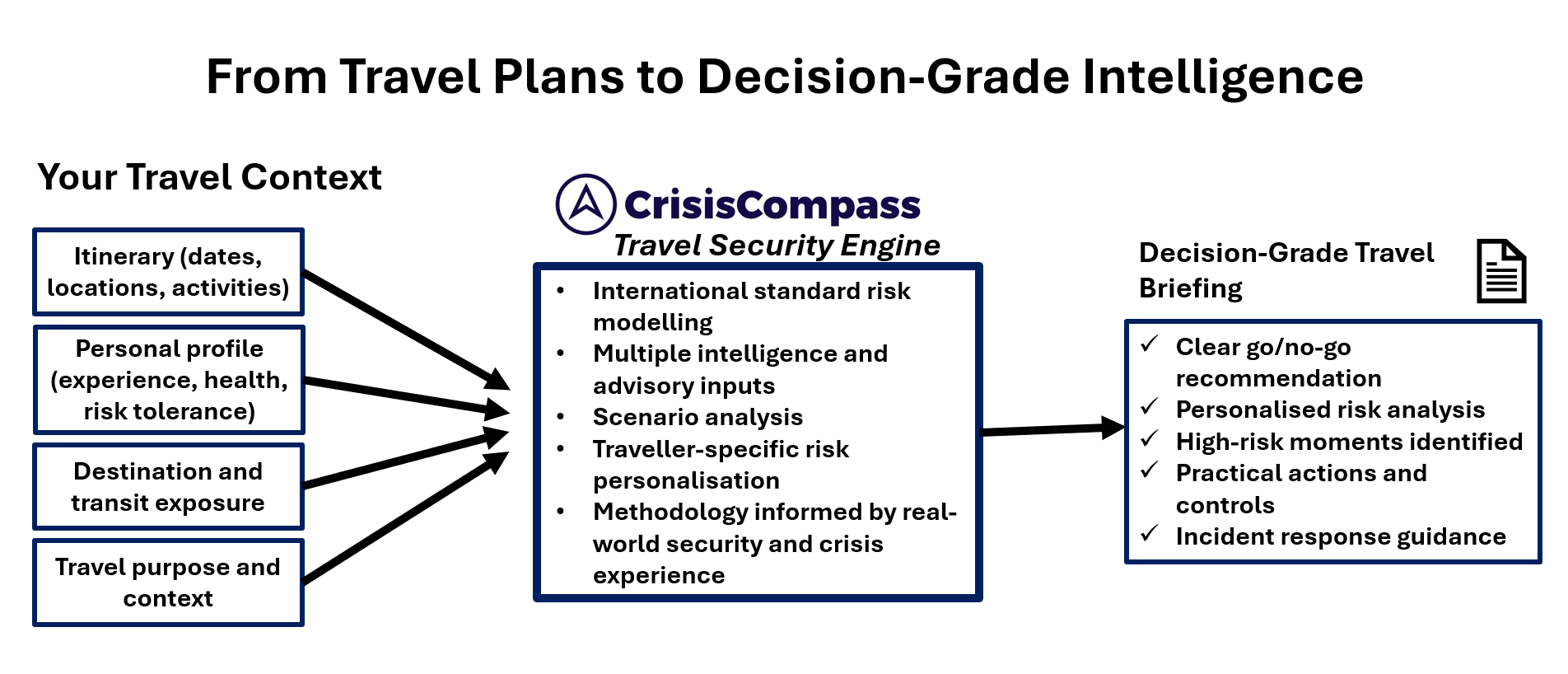
Upload your travel itinerary, travel profile and any relevant personal or medical considerations. The more detail you provide, the more precise and tailored your briefing will be.
We analyse your trip using the CrisisCompass Travel Security Engine - identifying where your itinerary is most exposed, and what that means for you in practice.
Receive your personalised travel security briefing and risk assessment via email within 24-48 hours - often significantly faster.
Pricing
Early Access: AUD$49
Standard price AUD$69
Built to support real-world go/no-go decisions.
Each briefing is reviewed and approved by an experienced security and crisis professional before delivery.
A fully personalised, itinerary-specific travel security briefing - not generic advice or automated output.
Early access pricing for a limited time.
Typically delivered within 12-24 hours (often sooner).
Professional-grade travel risk intelligence - for less than the cost of a single airport transfer.
What you get
A fully personalised, professional-grade travel security briefing designed to support real-world decisions - not generic checklists or broad country advice.
✓ Clear executive recommendation
Know whether your travel is recommended or not - and why.
✓ Personalised risk analysis
Built around your itinerary, profile and real exposure - not generic assumptions.
✓ Scenario-based incident response
Know exactly what to do when something goes wrong.
✓ Critical emergency information
Immediate access to the contacts and services you need, when you need them.
✓ Structured, professional briefing
Delivered as a clear, ready-to-use PDF designed for real-world application.
Each briefing is generated based on your personal profile, itinerary, and real-world exposure - not just the destination.
Example 3: High-Risk Destination Briefing
A personalised briefing for a traveller visiting Johannesburg for short-term work, with prior international experience but limited familiarity with the destination. No significant medical conditions were declared.
The traveller indicated they will be staying in secured accommodation, using a combination of private transport and locally arranged drivers and travelling between key sites where security conditions may vary. Movement may include exposure to higher-crime areas and environments where situational awareness and controlled movement are essential.
This example demonstrates how CrisisCompass assesses elevated crime risk, infrastructure variability and emergency response considerations - providing clear boundaries, risk tolerance guidance and scenario-based actions to support safe movement in a higher-risk urban environment.
Example 1: Leisure Travel with Personal Risk Factors
A personalised briefing for an 18-year-old female solo (and first-time) traveller with a severe nut allergy, mild asthma and limited local familiarity visiting Bali.
The traveller indicated they were planning to stay in a mix of hostels and budget villas. Intends to go out to nightlife venues and beach clubs. Will be using local transport (including scooters or rideshare apps).
This example demonstrates how CrisisCompass identifies life-critical risks, translates them into clear decisions, and provides practical guidance for navigating food safety, transport and day-to-day exposure.
Example 2: Corporate Travel Risk Assessment
A personalised briefing for a mid-level corporate traveller visiting Dubai for business meetings and short-term project work, travelling alone with moderate international experience and no declared medical conditions.
The traveller indicated they will be staying in a reputable international hotel, using pre-arranged airport transfers and rideshare services, and attending meetings across multiple urban locations. Evening movement is expected to be limited, with no planned nightlife or high-risk activities.
This example demonstrates how CrisisCompass delivers clear, executive-level recommendations - focusing on secure movement, accommodation risk, low-profile behaviour and practical compliance with local laws and cultural expectations in a global business environment.
Every CrisisCompass briefing is reviewed and approved by an experienced security and crisis professional - with real-world exposure across government, diplomatic, corporate and high-threat environments.
You get the depth of a bespoke security consultation - for a fraction of the cost.
Scroll through full, real briefings below - these are interactive examples of actual outputs.
FAQs
Have questions before requesting your Travel Security Risk Assessment and Briefing?
-
A Travel Risk Assessment and Security Briefing provides a structured analysis of safety, security, and operational risks associated with your destination.
CrisisCompass briefings analyse factors including:
Crime and personal safety risks
Civil unrest and political instability
Terrorism and security threats
Health and medical considerations
Infrastructure reliability
Cyber and technological risks
Environmental and natural hazards
The goal is to ensure travellers understand the specific risks associated with their itinerary and how to mitigate them.
These briefings help travellers understand issues such as crime, civil unrest, health considerations, infrastructure reliability, and environmental hazards so they can better prepare for their trip.
-
CrisisCompass travel briefings are designed for:
Business travellers
Corporate risk and security teams
NGOs and aid organisations
Journalists and researchers
High-net-worth individuals
Anyone travelling to unfamiliar or higher-risk destinations
The platform is particularly valuable for travellers visiting emerging markets or complex security environments.
-
Once your itinerary has been submitted, the CrisisCompass analyses the information you provided and develops the comprehensive assessment based on relevant intelligence sources.
Most briefings are delivered within 12 hours - but proposed travel to more complex or hostile environments will obviously take longer - but typically within 24 hours.
Once complete, the report is emailed directly to the client via the email address provided during the process.
-
CrisisCompass was developed by security and risk management professionals with experience supporting international travel and operations in complex environments.
This includes operational and advisory experience across regions such as Afghanistan, Africa, the Middle East, Russia, China, Papua New Guinea, the Philippines, Indonesia and the Asia-Pacific more broadly.
The platform applies structured risk analysis methods commonly used in corporate security and international risk management.
-
The process is simple:
Submit your travel itinerary through the secure portal
Our system analyses the destinations and travel dates
Relevant government and open-source intelligence is assessed
A structured briefing is prepared that explains what the threats and risks are, why they are relevant to you and you travel/profile specifically, and what to do about it
Your briefing is delivered via email as a PDF
Most briefings are delivered within 12 hours - but proposed travel to more complex or hostile environments will obviously take longer - but typically within 24 hours.
-
To generate a tailored briefing, we require the following information:
Destination country and cities
Travel dates
Accommodation locations (if known)
Planned activities (optional)
Any uploaded itinerary documents
The more detailed your itinerary, the more tailored the briefing will be.
-
Each report is generated specifically for your itinerary and your profile based on a number of risk and threat factors derived from the information you provided.
-
CrisisCompass briefings analyse information from a combination of sources, including:
Government travel advisories
International risk and security datasets
Open-source intelligence
Current news reporting
Historical incident patterns
These inputs are analysed to produce a structured and readable briefing.
-
We use intelligence and reporting available at the time the briefing is generated.
However, risk environments can change quickly. For this reason, travellers should monitor conditions and government travel advisories as their departure date approaches.
-
Each briefing typically includes:
Destination risk overview
Crime and personal security assessment
Political and civil unrest risk
Terrorism risk profile
Health considerations
Environmental hazards
Infrastructure reliability
Practical travel safety recommendations
Reports are typically around 15 -20 pages depending on the complexity of the proposed destination and structured for easy reading.
-
Yes. If your itinerary presents unacceptable risk, the briefing will clearly state this and explain why - along with safer alternatives where possible.
-
Once your briefing is finalised, you will receive it by email to the address you nominated during the upload process.
Reports are delivered in PDF format so they can be easily saved or shared.
-
Travel itineraries and uploaded documents are processed using secure cloud infrastructure.
Sensitive travel data is not shared with third parties, however CrisisCompass cannot be held responsible for you sharing your briefing with other people - which will contain references to the personal information you included.
-
Yes - the risk assessment and security briefing are yours to share as required; but note that security and threat information can change rapidly so the assessment can only assess threat and risk at the point you request the briefing.
The PDF briefing can be shared with colleagues, travel coordinators, or security teams to ensure everyone understands the relevant risks.
-
CrisisCompass briefings are designed to support travel risk awareness and planning.
They should be used alongside organisational travel policies, security guidance, and official government advice where applicable.
If required, CrisisCompass can supplement the briefing with a detailed and specifically developed comprehensive high risk travel plan. Reach out via info@crisiscompass.com.au if this is a service you need. -
If your itinerary changes significantly, you should request a new briefing so the risk assessment reflects your updated plans.
-
Yes.
Travel security briefings are widely used by corporate security and risk management teams to prepare staff travelling internationally. Briefings like this are routinely used by government and private sector security advisors to assess and plan travel to remote, high-risk or unfamiliar destinations.
CrisisCompass provides a structured briefing process that allows travellers to access similar destination risk analysis quickly and on demand.
-
Government travel advisories provide high-level guidance for entire countries.
CrisisCompass travel briefings analyse a wider range of security considerations and present them in a structured format designed specifically for travellers.
In addition to official government advisories, the analysis considers factors such as:
recent security incidents
crime patterns affecting travellers
political and civil unrest developments
infrastructure reliability
health and environmental risks
This provides travellers with a more comprehensive destination risk overview. Additionally, government security advice doesn’t consider your risk profile at all, whereas CrisisCompass product specifically analyses your profile and tailors the assessment and understanding of risk to you.
-
Travel risk information is often fragmented across multiple sources and can be difficult to interpret.
CrisisCompass consolidates relevant intelligence and presents it in a single structured briefing, allowing travellers to quickly understand the key risks associated with their destination and how to manage them.
This removes the need to review multiple sources individually and ensures important risks are not overlooked.
-
Travel security briefings are particularly valuable when:
travelling to unfamiliar destinations
visiting locations with elevated crime or security risks
travelling for business purposes
conducting fieldwork or research overseas
planning travel to emerging markets
Many organisations conduct travel briefings before staff travel internationally, particularly when visiting higher-risk environments.